
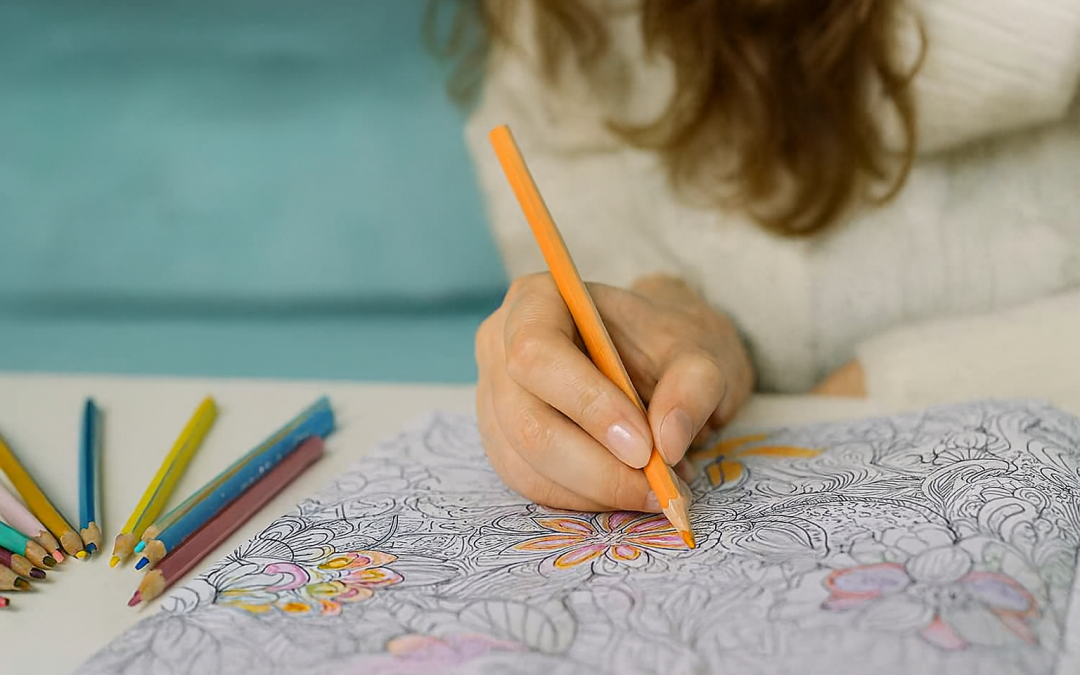
In a world where stress feels constant and the pressure to “keep it together” never stops, more women are returning to something surprisingly simple: coloring. Not the kind you did as a kid (though that joy counts too)—but intentional, thoughtfully designed adult coloring books created with stress relief in mind.
If you’re overwhelmed, overthinking, or struggling to shut your mind off at the end of the day, coloring can offer something your nervous system desperately needs: a moment of safe, structured calm.
This isn’t fluff. The benefits are backed by neuroscience, psychology, and decades of research on how the brain responds to repetitive, rhythmic, low-stakes activities.
Let’s break down why adult coloring works, how it reduces anxiety, and how you can use it as part of a holistic stress-management routine that actually fits your life.
1. Why Coloring Works: The Neuroscience of Calm
When you’re anxious, your brain shifts into a stress-response state—your amygdala fires, your body produces cortisol, and your thoughts race ahead faster than you can catch them. Coloring interrupts this cycle in three important ways:
—> It engages your “task-positive network.”
This is the system in the brain responsible for focus and problem-solving. When you begin coloring, your brain redirects energy away from anxiety loops and into the present moment.
Think of it as gently pulling your mind out of the future (what might go wrong) and bringing it back to right now.
—> It mimics the effects of meditation—without forcing silence.
Not everyone can sit cross-legged and quiet their thoughts. Coloring is a form of active mindfulness, which means your hands stay busy while your mind softens.
Research shows that repetitive, intentional movements—like shading or filling in shapes—activate the parasympathetic nervous system, lowering heart rate and calming breath.
—> It reduces the cognitive load placed on your brain.
When anxiety is high, your prefrontal cortex becomes overloaded. Coloring gives your brain a structured, predictable task. That predictability is soothing because:
- There are no wrong answers
- There’s no outcome to achieve
- There’s no performance pressure
Just lines, colors, and easing tension one stroke at a time.
2. The Psychology of Why Coloring Helps Anxiety
From a mental and emotional perspective, coloring offers several deeply therapeutic benefits:
It creates a sense of control.
Many people with anxiety feel like life is “happening to them.” Coloring gives you a space where you decide the rules—color, pace, direction. That sense of agency is emotionally regulating.
It interrupts intrusive thoughts.
Coloring works like a gentle pattern break. It stops your mind from spiraling and gives your brain something neutral to latch onto.
It stimulates creativity—the antidote to overthinking.
Anxiety is rigid. Creativity is flexible. Coloring helps you shift out of black-and-white thinking and into a more open, grounded mindset.
It taps into nostalgia and safety.
Coloring can bring back the comfort of childhood—times when life felt simpler and you didn’t have to be “on” all the time. That emotional association alone calms the nervous system.
3. Coloring vs. Scrolling: Why Your Brain Prefers Coloring
When you’re stressed, it’s easy to fall into doom-scrolling or binge-watching as a form of escape. But here’s the difference:
- Scrolling overstimulates your brain.More input = more overwhelm.
- Coloring reduces stimuli. Less input = deeper calm.
Coloring slows your mind, steadies your body, and helps you re-regulate from the inside out—unlike screens, which often increase mental clutter and emotional fatigue.
4. What Types of Coloring Pages Reduce Anxiety the Most?
Not all pages are equal. Certain designs actually calm the brain more effectively.
Best Styles for Stress Relief
✔ Geometric shapes✔ Repeating patterns✔ Mandalas✔ Floral designs✔ Abstract symmetry✔ Gentle curves and flowing lines
These designs activate the same parts of the brain involved in meditation, regulation, and relaxation.
Avoid if You’re Highly Anxious:
✘ Pages with extremely tiny details
✘ Overly dense linework
✘ Hyper-complex patterns
✘ Scenes that feel chaotic
These can overwhelm the nervous system and increase frustration.
5. How Coloring Helps with High-Functioning Anxiety
Many women experience what’s called high-functioning anxiety—a state where you appear put together but internally feel:
- On edge
- Exhausted
- Hyper-responsible
- Perfectionistic
- Worried about “dropping the ball”
Coloring gives these women a rare opportunity to practice:
- Slowing down without guilt
- Doing something with no expectations
- Giving their brain space to breathe
- Releasing perfectionism
- Reconnecting with internal safety
It’s especially helpful during:
- Lunch breaks
- Evenings after work
- Sunday “reset” routines
- During stressful project seasons
- Before sleep
6. How to Start a Coloring Ritual for Anxiety Relief
If you want to get the maximum calming effect, treat coloring like a grounding practice—not just a hobby.
Step 1: Choose a time when your anxiety tends to spike.
Morning rush?Workday overwhelm?Before bed?
Start there.
Step 2: Create a 5–10 minute ritual.
You don’t need an hour. Consistency is more healing.
- Light a candle
- Play soft music
- Deep breath in for 4, out for 6
- Begin coloring gently
Step 3: Use your body as a guide.
Coloring should feel relaxing, not stressful.If you notice tension building, shift pages or change colors.
Step 4: Pair it with affirmations.
For example:“Right now, I’m safe.”“I can slow down without losing control.”“I’m allowed to rest.”“I choose calm over chaos.”
Step 5: End with a 30-second reflection.
Ask yourself:
- How does my body feel now?
- Did my thoughts slow down?
- What do I need next?
This creates a mind-body connection that strengthens over time.
7. Why Coloring Is a Holistic, Whole-Person Approach to Anxiety
Coloring is one tool in a larger ecosystem of healing that includes:
- Breathwork
- Body awareness
- Healthy boundaries
- Mindset shifts
- Values-based living
- Sleep hygiene
- Nourishment
- Emotional processing
Coloring serves as the bridge between mind and body.It grounds your nervous system so you can think more clearly, choose healthier actions, and connect to what truly matters.
It’s not about being artistic. It’s about being regulated.
8. When Coloring Helps—and When to Seek More Support
Coloring is powerful, but it’s not a cure-all.
It helps when you are:
- Overstimulated
- Anxious but functional
- Stressed from work
- Experiencing everyday worry
- Feeling overwhelmed or scattered
- Dealing with racing thoughts
Seek additional support if you experience:
- Panic attacks
- Chronic insomnia
- Severe emotional numbness
- Trauma responses
- Anxiety impacting work or relationships
- Feeling constantly on edge
Coloring is a supportive practice, but it shouldn’t replace personalized mental health care when needed.
Final Thoughts: Calm Is Built in Small, Consistent Moments
Adult coloring books offer something deeply healing in a busy, high-pressure world: A pause. A breath. A moment of softness inside your day.
Coloring doesn’t ask you to be perfect. It doesn’t ask you to be productive. It simply asks you to show up—and let your nervous system remember what calm feels like.
And from that place of calm, everything becomes more manageable.